
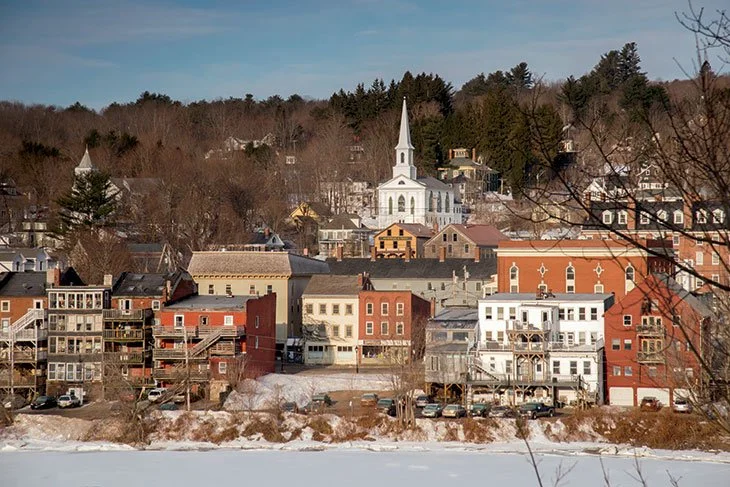
One afternoon in March of 1851, a farmer and a country shoemaker began to talk about the state of their small Baptist church in their small Maine town. The church, both agreed, was in a poor state. It had been without a pastor for some time and so was only able to hold occasional services when a visiting minister could be found. These visiting ministers didn’t find much encouragement in the New Gloucester Baptist Church when they arrived. Rather, they found “a congregation most discouraging in numbers and disheartening in interest.” The struggles of the church were reflected in the poor spiritual state of the whole community and in particular in the attitudes and actions of the young. But that afternoon each man discovered in the other a burden for the church. And right then and there, they began to form a plan of action.
I discovered the story of the farmer and the shoemaker in the writings of the man in whose memory our church is named. Penney Memorial United Baptist Church in Augusta was named after Dr. Charles Fox Penney, who pastored there for 25 years at the end of the 1800’s. As a new pastor at Penney, I began to explore the history of the church and found a series of articles Dr. Penney wrote in the last years of his life called “Revival Memories,” all of which were published in a local Augusta newspaper. He wrote six articles recording works of revival that he witnessed in central Maine and a seventh article summarizing the lessons learned from these experiences. The articles are full of interesting material, but the stories I’ve found myself reflecting on most are two stories of twin revivals (separated by fifteen years) in little New Gloucester, Maine. Both revivals began with a farmer and a shoemaker burdened for their local church.
The plan the men hatched was to get a minister (the currently unemployed Rev. William Nevens) to come into town and hold a series of revival services in the church. They planned to have a service every night for a week, starting March 28th. Then, for the second week, they would have two services a day – one in the afternoon, followed by another in the evening. Two weeks of at least daily services, praying for God to resurrect the church and reach the lost.
They began with a sincere burden and no doubt, with hopeful hearts. However by the end of two weeks, Dr. Penney writes, “A more discouraging outlook could hardly be pictured.” The meetings started small and in two weeks had hardly grown. Some town folk came once or twice, only to leave. Charles Penney himself, who was 19 at the time, was among the group of “irreligious youth” in the town that so burdened the hearts of the farmer and the shoemaker. He came with some friends to a meeting or two but was generally immune to the pull of the preaching. There was one moment, however, that provoked him. The preacher challenged the youth on their use of profanity. The critique hit Penney rather hard. “My own personal habit,” he wrote, “made it seem like a personal attack.”
After two weeks, the meetings were not bearing fruit. Undeterred, the small core of the New Gloucester Baptist Church made the decision to carry on. A third week of afternoon and evening services were scheduled. On the third week, Monday, Tuesday, Wednesday, Thursday and Friday services were held, all with little effect.
On Saturday of the third week, in the afternoon service, a woman asked the small gathering to pray for her backslidden husband. For one hour they prayed together for this man, who was at that same moment working nearby in his field. As they prayed, unbeknownst to the small gathering in the church, the Holy Spirit was initiating a powerful work in the man’s heart.
The man, Penney writes, “had seen his wife, with others, on their way to the service” and he was at the time “unmoved.” But “while at his work that afternoon he became strongly wrought upon. The praying people in the church rebuked his own prayerlessness. His neglect of God’s house, his home altar broken down, his own godless life of wandering, moved him with a power he could not understand.” Then and there he resolved to attend the service that evening.
The Holy Spirit was not just working in the life of this husband. Young Charles Penney was also working that afternoon with no plan to attend the service. But while he worked, his spirit was greatly disturbed “by the thought of my own godless life, my habit of profanity, and my utter thoughtlessness concerning the best interests of my life.”
I doubt that either the famer or the shoemaker or any other in that small faithful group anticipated as they came to church that Saturday evening—after nearly three weeks of regular services—that two men under heavy conviction would be in attendance that night. But when the service began, it was not long underway before the man for whom they’d prayed that afternoon stood up and began to confess his sin. Dr. Penney, who again was also in attendance, recorded the man’s confession:
“He related his experience of the afternoon…his sorrow at the godless life he had led, his regret at the example he had set before the young men of the community, and then, turning toward the pew where I sat with other young men, he said in brokenness and tears, ‘My young friends, I want you to forgive the example I have set before you the past winter as I have already asked God to forgive my sad wanderings from him.”
The man’s words, Penney wrote, “pierced my heart like an arrow.” By the end of the service, Penney stood to request prayer along with another young man. The next morning at the Sunday service, fourteen people (including Penney) went forward to the “anxious seat”—a place of prayer at the front of the church where those under conviction could go to request the prayers of God’s people. Two days later, still unsure of his salvation, Charles Penney was walking to the church for a prayer service on a cold and stormy early spring afternoon:
“There first dawned upon me the truth that, having met all the conditions of salvation, I had assured right to claim the salvation. Then I believed; trusting to what God had said, and not to my own feelings. The assurance grew in my heart to my measureless comfort; and I returned to my home through the two miles of darkness and storm, singing over and over and again on the way Charles Wesley’s sweet hymn of confidence and trust:
‘My God is reconciled; His pardoning voice I hear; He owns me for his child; I can no longer fear. With confidence I now draw nigh, And ‘Father, Abba, Father,’ cry.”
Penney was never the same. He wrote the above account 47 years later. He wrote as a man near the end of a 15-year battle with a mysterious illness that would cause him great suffering, force him to leave successful pastorates, undergo a series of eight unsuccessful surgeries, and eventually die at age 67. Yet in the midst of those circumstances, all those years later, Penney writes of his conversion: “the assurance that dawned upon my soul has continued through the varying experiences of my life, quieting my fears and keeping my heart in the peace of God.”
A little over a month later in 1851, the New Gloucester Baptist Church held a baptism service at a local pond for seventeen new converts, Penney among them. Modest numbers for some of today’s megachurches perhaps, but astonishing numbers for a small Maine town and enough to give the church new life. The real power of this renewal that began in the shoemaker’s shop, however, was in the lasting conversions of those like Penney, and in the fruit that these converts would bear. This included gospel fruit in New Gloucester itself, some 15 years later.
Fast forward fifteen years, and Charles Penney was a man of 34, a graduate of Bates College a few years into his first pastorate in Augusta. Though he had been away from New Gloucester for some time, he continued to have a concern for his hometown church, which was again struggling to survive. This time much of the cause of the church’s hardship was the devastating effect of the Civil War. Many leading members of the church had gone to serve in the war and had not returned. The church, already small, had again been unable to pay a minister, making services infrequent. By 1866, Penney writes, “There was no meeting of prayer; the Sunday School was discontinued; and the membership gradually diminished till at that time there were only nineteen resident members.” He adds, “It was a season of great religious declension and discouragement.”
Penney was burdened for the church and looking for an opportunity to help when he learned that the Baptist Cumberland Association Quarterly Meeting was scheduled to be held in New Gloucester starting on October 31st. Penney was invited to preach—which was the opportunity he had been looking for. He worked with some other area ministers to begin services of preaching and prayer in the church starting with the Quarterly Meeting and following for several days afterwards. By November 15th, the meetings were still being held, and nearly from the start people from the town and beyond were attending the meetings, professing conversion and seeking baptism.
Penney writes:
“The work extended over a wide area and reached many neighborhoods and families two and three miles distant from the church. The converts included children, young men and women, and many advanced in years. At the first baptism there were thirteen heads of families. Among the converts was my own father, at that time over sixty years of age.”
By mid-December, fifty people had professed conversion and a “large number…reclaimed from backsliding.” To support the ongoing work in New Gloucester, the people had raised $400 as salary for a new minister and even had one hired. “All this,” Penney wrote at the time, “in four weeks, and the work still going on.”
What had initiated this second, even more substantial, work of renewal in New Gloucester? Dr. Penney didn’t take any credit for himself, but said part of the “secret” of this revival was found in the faithful prayers of two elderly members of the congregation. This time it wasn’t the famer and the shoemaker, but two women, who had met together to pray every week for the church, “that it might be revived and sinners converted.”
New Gloucester was—and is—a small, rural town in Maine. I think it’s a safe bet that you will never read about it in church history books or ever see it on the national news. But the earth is the Lord’s and the fullness thereof. There is no place that’s insignificant to him and so no place where the Kingdom of our God and of his Christ might not break in, in the power of the Holy Spirit. We have a record of this happening twice when the small Baptist church in town was almost dead, and breaking in with results that can’t really be numbered. Charles Penney’s life was forever changed. He also changed the town of Augusta, has been an inspiration to me, and by God’s grace the lessons he learned may still be used to bring renewal to the church that today is named in his memory. I hope these stories may be an inspiration to you as well.
What lessons did Charles Penney learn from these revivals that so shaped his life and ministry? Less than a year before he died, he wrote a final article in the “Revival Memories” series, entitled “Lessons of Experience.” He wrote down these “lessons” for others who may hope to see revival in their day, in their own hometowns and struggling churches:
Among the things that my experience has emphasized is that revivals are no mere matter of human device and machinery. The phrase, “getting up a revival,” savors too much of man’s agency. Revivals are never gotten up; they are brought down. They are not subject to order; they are born of God. There is just one agent absolutely indispensible to a revival—God’s Spirit. There is just one instrument absolutely indispensible to revival—God’s Truth. All else is minor, secondary, variable, incidental, dispensable. The Holy Spirit and the Book are the needed agent and instrument in consecrated hands for the work.
The Book, however, must be God’s Book, infallible, of divine authority and perfect inspiration. The Holy Spirit will never honor the preaching of the myths and sacred legends of the higher critics to the saving of souls.
What then can be done? Preach the gospel and pray, with a burden for souls and hope in the power of the Holy Spirit and the Bible he inspired. And by God’s grace, may we see churches revived all over New England.
Justin Frank
Justin Frank is originally from Portland, Oregon. He came to New England in 2001 to study at Gordon-Conwell Theological Seminary. While there he met and then married a girl from Maine, and he’s been in New England ever since. He and his wife Kellie have been married for almost 20 years and have four kids. After pastoring in Gloucester, Massachusetts, he was called to be the pastor of Penney Memorial in 2014. He lives in Augusta and is the chaplain for the Augusta Police Department.