
This is Part 2 of a two-part Small Town Summits Article. Part 1 was published September 1st and can be found HERE.
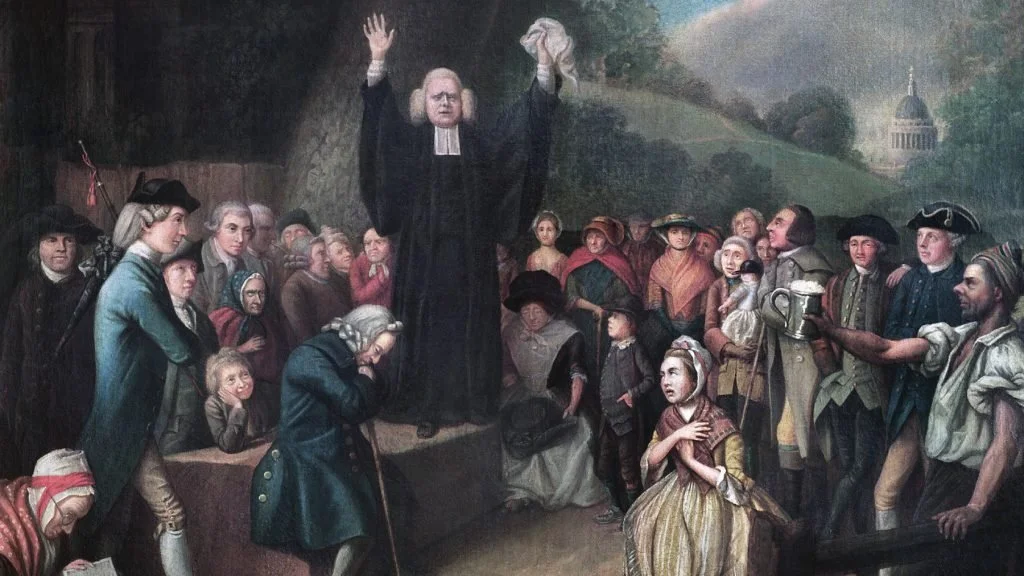
George Whitefield's first voyage to America aboard The Whitaker has yielded surprising pastoral wisdom for me as a small-town pastor in New England. Whitefield’s remarkable ministry, springing from his faithfulness and witnessing God’s fruitfulness, remind us that it is not about George.
Whitefield’s delight was to see people worshiping the Lord, without himself at the center. If his persistent prayers and hymn-singing led people to worship without him present, it was that much more a sign of fruitfulness:
“I was pleased to hear from some Gibraltar officers, who dined that day on board the Whitaker, that some of my flock had the courage to read prayers and sing psalms themselves, and (as I found afterwards) continued so to do, during my absence from them. Blessed be God!” (1)
Like a small-town pastor who wants to see his church’s survival persist beyond his presence, so Whitefield celebrated God’s work with himself removed. He knew that it would not be long before they were at their destination and his time with them was up.
No doubt he was weary of his growing influence and celebrity status. It was a source of constant prayer: “O grant I may, like a pure crystal, transmit all the light Thou pourest over me, and never claim as my own what is Thy sole property!” Whitefield saw his unique preaching ministry as merely a gift from “The Rock” from which he was cut.
Awareness of the danger of this popularity of his preaching had already taken place before he boarded The Whitaker, while still in England. Crowds gathered, and pleaded with him not to go to America. It was then that he began to learn how to pursue humility relentlessly. He wrote while still in England before leaving for the Colonies:
"The tide of popularity now began to turn very high. In a short time, I could no longer walk on foot as usual, but was constrained to go in a coach, from place to place, to avoid the hosannas of the multitude. They grew quite extravagant in their applauses; and, had it not been for my compassionate High Priest, popularity would have destroyed me. I used to plead with Him, to take me by the hand and lead me unhurt through this fiery furnace. He heard my request, and gave me to see the vanity of all commendations but His own."
This is a stark reminder to us that no matter how God blesses our ministry, through small graces or extraordinary works, all commendations are vanity “but His own.”
Delighting in and Fearing Creation
Whitefield used this opportunity at sea to enjoy the beauty of God’s creation. At times in his journals, he commented, “delighted in seeing the porpoises roll about the great deep.” Not just the dolphins but sharks as well: “In the midst of our meal we were entertained with a most agreeable sight. It was a shark about the length of a man, which followed our ship, attended with five little fishes called the Pilot Fish, much like mackerel, but larger.” His time on board offered him freedom to pray, to reflect, and to admire the beauty of the Lord.
The sea is not always so amicable to ships. Squalls and storms were not uncommon, and could be truly terrifying. Whitefield thanked the Lord for what he saw as supernatural protection:
“We saw one of [the waterspouts] coming, and were surprised to observe a sudden calm for about six minutes round the Whitaker, when the other parts of the sea boiled like a pot. Surely the Everlasting I AM said to the sea at that instant, Let there be a calm in that place;”
Not all of his transatlantic journeys would go so well. During his return voyage on The Mary, they nearly ran out of water and food. The storms were almost unbearable before they eventually docked safely in Ireland.
Long weeks confined together led to full sickbeds. More often than not, the Lord protected Whitefield from sickness as he ministered regularly to the ill: “Visited near twelve or fourteen sick persons, and yet such is God’s mercy to me, that though the place where they lie is much confined, and they catch the fever of one another, yet God keeps me from infection. The way of duty is the way of safety.” However, at least once, Whitefield fell deathly ill. He saw this as a chastening, to help him to not boast too much of good health.
One of the blessings of small-town ministry is often proximity to natural beauty. It gives us the opportunity to enjoy a morning coffee with the tree line in sight. It also affords us the privilege of getting to know people personally in our community, as Whitefield did on the ship. We can hold their hands through the storms and walk side-by-side through the calm. And when we get sick or injured, as we inevitably will, we can feel the care of the small-town crew.
A Tearful Goodbye
When some soldiers left Gibraltar before Whitefield did, “Many officers and soldiers wept sorely, and a visible alteration was observed in the garrison for some days after.” On his last day at Gibraltar, “many came to me weeping, telling me what God had done for their souls, desiring my prayers, and promising me theirs in return. Others both gave and sent me tokens of their love, as cake, figs, wine, eggs, and other necessaries from my voyage, and seemed to want words to express their affection.” It was said of Whitefield’s preaching that he seldom finished a sermon without sobbing in tears. Could this emotional sensitivity be at least partly due to experiences like this in his early 20s?
The effect of Whitefield’s ministry aboard The Whitaker was more than fleeting experiences. The voyage began with profanity and drunkenness and ended with peace and the sounds of hymn singing. The fruit of his ministry was the mark of his anointed preaching. “Many marks of a sound conversion appear in several on board, and we live in perfect harmony and peace, loving and believed by one another.”
This was all God’s blessing for that season of Whitefield’s life and ministry. His next journey, from Charleston to Ireland aboard The Mary was different. Whitefield recognized only one convert:
“As for the success of my ministry whilst on board, I shall only say, much sin has been prevented, and one I hope effectually converted, who is to be my fellow-traveler to England. Lord, if I can but be made instrumental to save one soul, I care not if I am tossed on the ocean through my whole life. Glory to God on high.”
Glory to God. The power of conversion is in His hands.
When the day comes to say good-bye to your church, may it be a day filled with tears. Tears because you love them, and they love you. Tears of gratitude to God for the time you invested in their lives, and the transformation you witnessed. Tears for how God sanctified you through them. Tears that say not good-bye, but till we meet again. And whatever the fruit borne from it, all glory to God.
Endnotes
All Whitefield quotes in this article are from Whitefield, George. George Whitefield's Journals. London: The Banner of Truth Trust, 1960.

Rick Harrington
Rick Harrington serves at First Baptist Church of Haverhill, MA as the senior pastor. He loves to travel the world, read good books, drink quality coffee, and spend time with his wife Jessica have two kids. His passion is to see the church deeply in love with Jesus, spreading the fame of His Name throughout the globe.
Rick graduated from Gordon College (B.A.) and Trinity Evangelical Divinity School (M.Div), and holds a doctorate degree in preaching from Gordon-Conwell Theological Seminary (D.Min). He serves as the Provost of the Multiplication Center of the Baptist Churches of New England.
He is the author of Churching: Rediscovering the Centrality of the Church in the Christian Life (2025). Rick has published with Baptist Press, The Baptist Paper, and The New York Times.