
This article is Part 1 of a two-part Small Town Summits Article.
In 1738, George Whitefield was only 23 years old but an active evangelist. His first sea voyage to America was aboard The Whitaker. In the years that followed, he would make 12 additional transatlantic trips, finally being laid to rest in Newburyport, MA. The first voyage in particular offers us a sort of helpful illustration for small town ministry.
Who was George Whitefield?
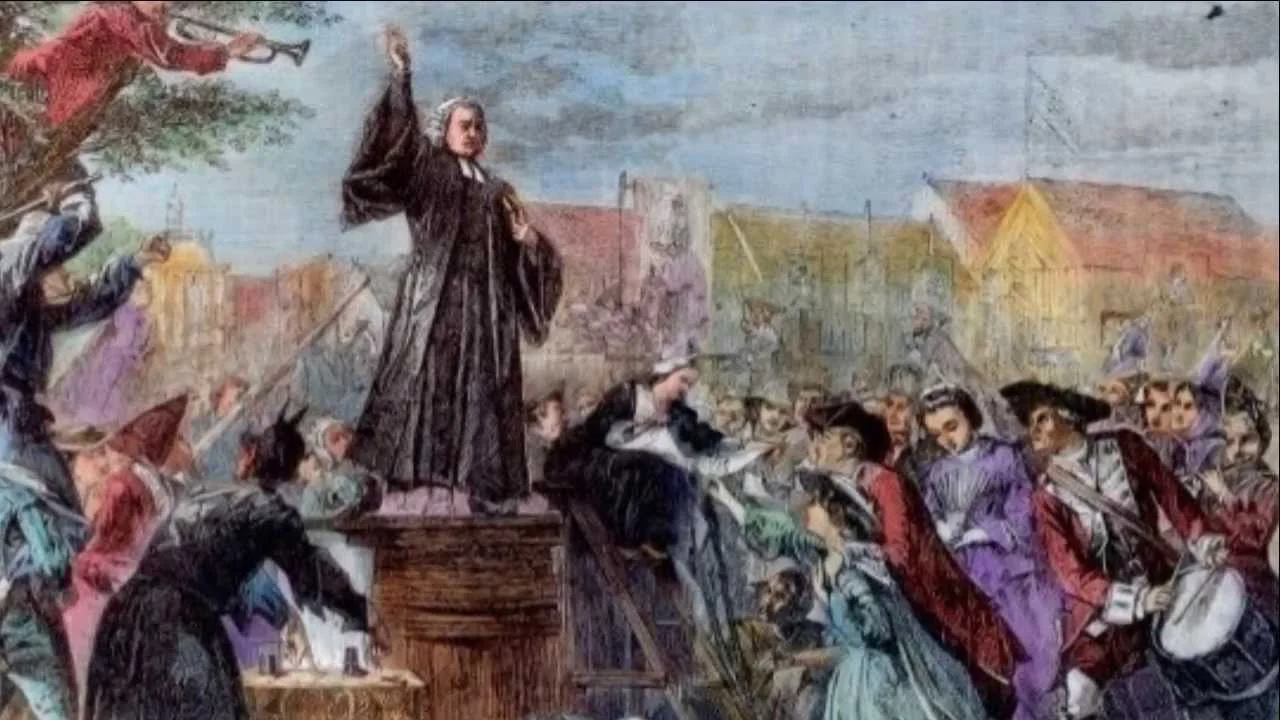
It is necessary to take a moment to note the remarkable ministry of George Whitefield. Even before embarking to America, Whitefield would fill church buildings beyond capacity. Eventually, due to size constraints and antagonism of contemporary clergy, Whitefield took to the open air. Coal miners with faces still blackened from the mines would come out in the thousands to hear him preach. No one had ever seen anything like it.
Whitefield’s ministry expanded to the Colonies. Crowds gathered in the open air up the Eastern coast from Georgia to New England, even into the tens of thousands, and this in a colonial America with slightly over a million people. Whitefield’s message was plain, emphasizing the new birth: “You must be born again!” His influence lived on. He fanned the Great Awakening into flame, along with Jonathan Edwards. Preachers who took up the mantle of Whitefield’s gospel-centric message were labeled New Lights. My own church, First Baptist Church of Haverhill, MA, was founded by a New Light preacher, Hezekiah Smith, in 1765.
In England, pastors like John Newton and hymn writers like William Cowper were the fruit of his ministry. One can trace a direct line from the preaching of Whitefield to the abolition of the slave trade spearheaded by William Wilberforce. Perhaps the only evangelist of modern times that can be seen as comparable in influence is Billy Graham.
Sea Voyages
To cross the Atlantic in the 1700s would take months. Unlike today, when we can book a trip to Heathrow, fly out in the evening, and arrive in London by morning, these were long and dangerous trips. Squalls and seasickness were common. Not all who embarked were guaranteed to disembark at journey’s end.
The Whitaker was a military ship, and George Whitefield acted as a chaplain aboard the vessel. He cared for not only the passengers but the sailors as well. He provided corporate worship to those interested and made use of the evangelistic opportunities that a small community aboard a secluded vehicle provided. The ship carried about a hundred passengers, with a crew running the vessel, making numerous stops along the way, most notably in Gibraltar, before completing the journey in Georgia.
In examining the voyage of The Whitaker, one can’t help but think of biblical sea voyages such as Jonah’s, Paul’s passage to Rome, and Jesus’s time on boats in the Sea of Galilee, strengthening the faith of his disciples. Whitefield made references to such events in his journals often. G. K. Chesterton wrote, “We men and women are all in the same boat, upon a stormy sea. We owe to each other a terrible and tragic loyalty.”” (1) Ministering in a small town finds its parallels, and Whitefield’s example presents us with some insights for small town ministry.
A Daily Whitefield
Perhaps one of the dangers for pastors in reading biographies of great preachers of the past, is to miss the importance of the ordinary. Fruitful ministry often takes years, if not decades. During that time God is shaping not just your people, but your own character and gifting. Like Whitefield, every day will not be beset with extraordinary works of God. They are often the result of long and hard preparation and emotionally-draining ministry.
We might be surprised to learn that Whitefield's ministry consisted primarily of mundane pastoral care practices rather than preaching to the myriads. It is from his journals during his first sea voyage across the Atlantic that we see what the daily ministry of Whitefield looked like. He originally wrote this portion of his journals simply for his friends to read. They were later published without his knowledge! While movies and brief bios will portray the heydays and remarkable crowds, these extraordinary moments were forged by the day-in and day-out prayers, catechizing, and pastoral care of “his flock” upon the Whitaker.
Most of Whitefield’s days consisted of morning prayers, catechisms, and visiting the sick. He would lead in hymn singing, a staple of protestant Christian worship in the 18th century. He performed weddings and some funerals, at least one for an infant. He counseled couples, delighting in the triumph of a restored marriage. He evangelized those in the stocks, including one prisoner who murdered a man while drunk.
As he saw it, it was his call to shepherd the flock entrusted to his care while on this journey. This would mean confronting the typical sins they would face, often railing against swearing and drunkenness. He guarded the reading material aboard the ship, sometimes trading valuables to get useless books out of the hands of passengers. In his journal he writes, “Exchanged some bad books that were on board (which I threw immediately into the sea), for some good ones.” (2)
In his private time, he wrote and read letters. He read a biography of Thomas Cranmer. He treasured Matthew Henry’s commentary on the Bible. He prayed alone in his cabin often. While docked, he would go on shore and meet with friends. He would attend churches to preach and fellowship with other ministers. His impact on the soldiers is particularly remarkable, even to him: “Who more unlikely to be wrought upon than soldiers? And yet, amongst any set of people, I have not been where God has made His power more to be known.”
Anointed Preaching
When we think of George Whitefield, we think of his preaching ministry. Upon the ship or on shore, he must have preached hundreds if not thousands of sermons. Most of them went by without great notice. The power of his preaching was more in the collective than in the singular. Over time, his command of the Scriptures, his deep emotion over the truths of the gospel, and his unique oratory, took effect. Add to this, a particularly unusual unction.
Upon The Whitaker, Whitefield’s preaching ministry increased gradually but quickly. At first, he was allowed to preach to the passengers and the soldiers but not the officers. Eventually the officers invited him to offer prayers, but not a sermon. Seeing the effect of his preaching on the soldiers, they invited him to preach for the officers, too! By the end of the voyage the crowds of officers and soldiers flocked to hear him preach at every opportunity.
While on shore, the soldiers and officers alike would disembark and follow Whitefield to hear him preach again and again: “Preached this morning in Gibraltar, before such a congregation of officers and soldiers as I never before saw. The church, though very large, was quite thronged; and God was pleased to shew me that He had given extraordinary success to my sermon. O how is the Divine strength magnified in my weakness!”
Here is where we might find Whitefield, however fascinating, to be the most unrelatable. Only a handful of men in history have had the preaching ministry he possessed. Still, that being the case, it is not uncommon for pastors to have a particular gifting in one area of ministry over and above the others. That may be counseling or personal evangelism, writing skills or musical gifts. Foster them. Fan them into flame. And as we struggle more in other areas of ministry, let that labor only help us do what we do well all the better, no matter how many we are ministering to.
Endnotes
Chesterton, G. K. The Collected Works of G.K. Chesterton, Volume 28: The Illustrated London News, 1908–1910.
All Whitefield quotes in this article are from Whitefield, George. George Whitefield's Journals. London: The Banner of Truth Trust, 1960.

Rick Harrington
Rick Harrington serves at First Baptist Church of Haverhill, MA as the senior pastor. He loves to travel the world, read good books, drink quality coffee, and spend time with his wife Jessica have two kids. His passion is to see the church deeply in love with Jesus, spreading the fame of His Name throughout the globe.
Rick graduated from Gordon College (B.A.) and Trinity Evangelical Divinity School (M.Div), and holds a doctorate degree in preaching from Gordon-Conwell Theological Seminary (D.Min). He serves as the Provost of the Multiplication Center of the Baptist Churches of New England.
He is the author of Churching: Rediscovering the Centrality of the Church in the Christian Life (2025). Rick has published with Baptist Press, The Baptist Paper, and The New York Times.